Write down what each number actually sees
A number counts all adjacent mines, including diagonals. Before comparing two clues, list their remaining unknown neighbors and subtract any mines already proven. An unverified flag is not a proven mine.
Suppose one clue says exactly one mine is in A or B. Another says exactly one mine is in A, B or C. The mine required by the second clue is already accounted for in A and B, so C is safe. This works because the first group is entirely contained in the second.
What changes when the second clue needs two mines?
If A+B contains one mine and A+B+C contains two, C must be a mine. More generally, subtract the smaller group’s remaining mine count from the larger group’s count. A difference of zero makes all extra squares safe. A difference equal to the number of extra squares makes all extras mines.
A difference of one with two extra squares only tells you that one of those two is a mine. It does not identify which one. Avoid turning a useful constraint into an unsupported click.
A safe square from the recorded board
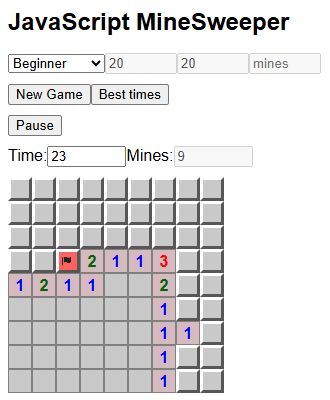
Coordinates below start at the top-left, with row and column numbers beginning at 1. On our recorded Beginner board, the clue at row 8, column 7 had three covered neighbors: (7,8), (8,8) and (9,8). The clue at (9,7) had only (8,8) and (9,8). Both clues were 1.
The shared pair therefore held the required mine, making (7,8) safe. Clicking it revealed another 1.
Do not apply a remembered shape without its surroundings
A familiar string of numbers can have extra covered neighbors above or beside it. Those squares change the equations. Check the full neighborhood, board edges and confirmed mines before using a pattern. If the groups overlap but neither contains the other, simple subtraction alone may not force a move.
Use flags to record conclusions, then look elsewhere if the remaining constraints do not settle the next click.
Try the next run
Use one idea from this guide in the Minesweeper player. Its game page includes controls and edition/source details.