Start a run
Press Space or the up arrow to start or jump. Use the down arrow to duck. Touch players can tap to start or jump. The dinosaur runs automatically, so your decisions concern avoiding obstacles rather than moving it forward.
UBG766 hosts wayou’s open-source T-Rex runner extraction. This is a locally hosted browser edition; it is not a promise that the surrounding website will load without an internet connection.
Judge the jump and the landing
Look at the leading edge of a cactus group and the ground after it. A jump needs enough height to clear the group and enough landing room before the following obstacle.
Holding the jump key can change the jump height. Practice short and longer presses while the run is slower. A long jump may clear a group but leave you in the air when you need to prepare for the next obstacle.
There is no single reliable distance to memorize for an entire run: the pace increases. Adjust your timing to how quickly the obstacle is approaching.
Choose whether to duck
Birds can appear at different heights. Look at the bird’s path relative to the dinosaur rather than treating every bird as a jumping signal. The down arrow makes the dinosaur lower; use it when that smaller profile provides a safe path beneath an obstacle.
On a keyboard, practice switching between jumping and ducking without looking down at your hands. Touch controls do not necessarily provide the same range of inputs, so choose a keyboard when you want to practice ducking specifically.
Break the repeated-jump habit
If you keep colliding immediately after landing, you may be staying airborne longer than needed. If you hit the front of a cactus, inspect whether you reacted too late. If you land inside a wide group, inspect whether the jump was too short or began too early.
Change one part of your timing at a time. Repeatedly pressing jump without looking at the next gap can hide the reason a run ended.
A useful practice session
- Play one run using deliberately short jumps over small obstacles.
- On the next run, focus on the space after each obstacle group.
- On a keyboard run, identify bird height before deciding to jump or duck.
Your score may fall while you learn a new habit. Use collision patterns to judge improvement instead of expecting every run to set a record.
A recorded play session: what happened
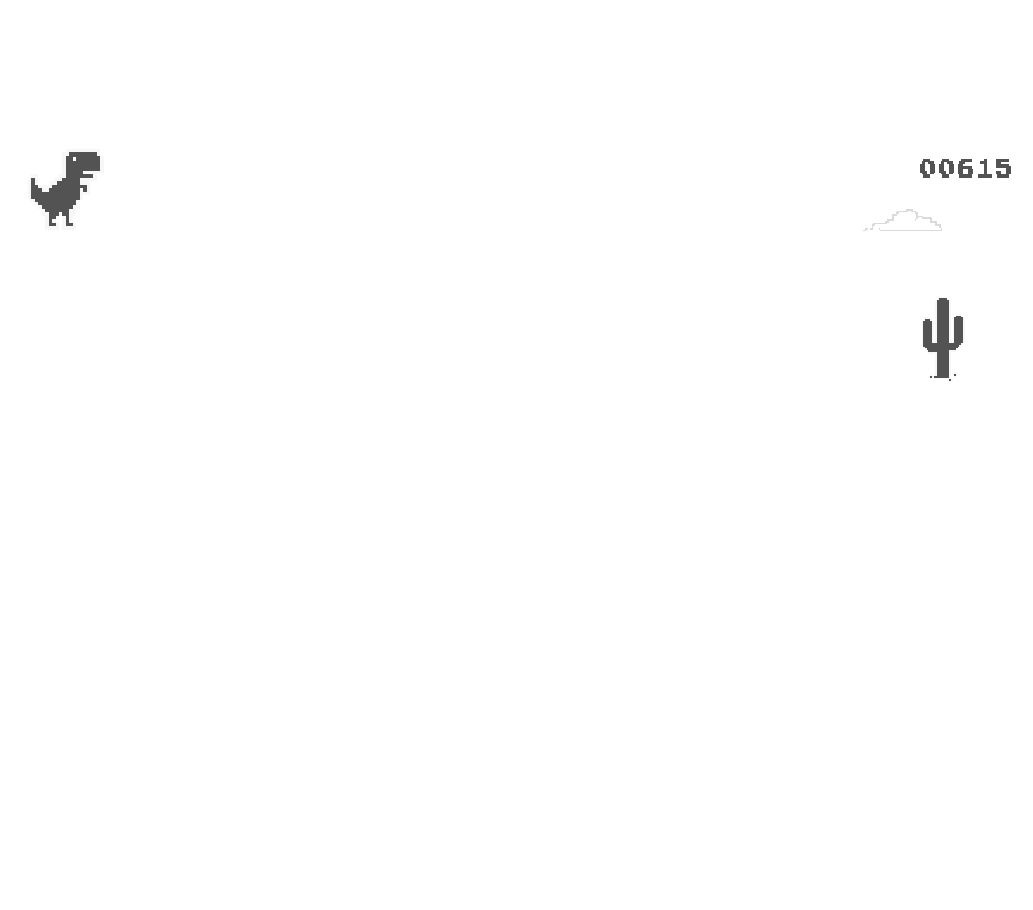
Start, jump and restart were exercised. The recorded run shows the dinosaur airborne at score 615, with another cactus approaching.
An earlier attempt ended at score 47 after a cactus collision. After restarting, we used the jump controls again. The capture below shows a later moment at score 615: the dinosaur is above the ground and another cactus is approaching from the right.
The screenshot is a timing example, not a recommended fixed jump distance. Judge the next obstacle together with the space needed to land. Jumping successfully once does not solve the next gap, especially as the pace changes.
Practice target: clear an obstacle, look for the next one, and make a separate decision about the next jump. This session verified basic running and jumping; it did not establish a high-score method or test every bird-height situation.
Try the next run
Use one idea from this guide in the Dinosaur Game player. Its game page includes controls and edition/source details.