Understand one move
The board has four rows and four columns. Use an arrow key, or swipe on a touch screen, to slide every tile in that direction. Equal tiles merge when they meet. A tile created by a merge cannot merge again during that same move. A valid move also introduces a new tile, so the next board is not completely under your control.
Your first goal is a 2048 tile. The local version lets you continue afterward. The run ends when there are no empty squares and no adjacent equal tiles that can merge.
A merge example
Imagine one row contains the following tiles. A dash means an empty square.
| Before sliding left | After the slide, before the new tile |
|---|---|
2 · 2 · 4 · — | 4 · 4 · — · — |
The first pair makes a 4. It does not immediately combine with the existing 4 to make 8. That would require another move. Plan around the board after the slide, then account for the new tile.
Build around a corner
- Choose a corner for your largest tile. The bottom-left is a useful starting choice.
- Try to arrange descending values along the bottom row, with the largest on the left.
- Use left and down moves when they help preserve that arrangement. A right move can shift the corner tile if there is a gap in its row.
- Before moving up, check whether it will pull your largest tile away from the corner. Sometimes that move is necessary to keep the board alive.
This is a planning habit, not a guaranteed winning sequence. Empty space and available merges take priority over following a rigid two-button pattern.
Mistakes that fill the board
Taking every available merge. A small merge can separate two larger tiles you were preparing to combine. Look at the full row or column first.
Chasing the largest tile only. Several small tiles scattered around it can block the next merge. Consolidate smaller values while keeping an escape move.
Pressing keys faster when stuck. Pause instead. Find where the next useful pair would meet and identify the move that gives it room.
A short practice routine
For your next three runs, focus on keeping your largest tile in the same corner and explaining each move before making it. When a run ends, find the first move that broke your arrangement. This is more useful than restarting until random moves produce a high score.
The R key starts a new game in this edition. Use it only when you intend to abandon the current board. Browser storage can retain progress, but clearing site data can erase it.
A recorded play session: what happened
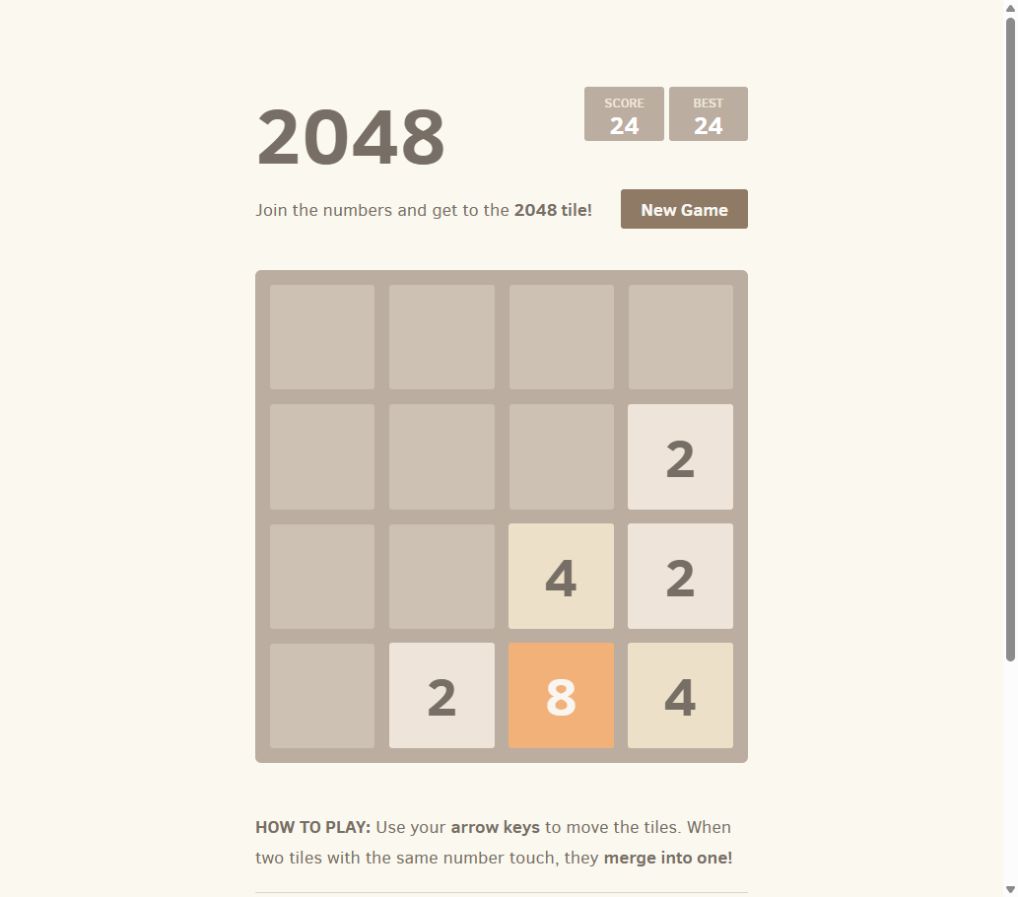
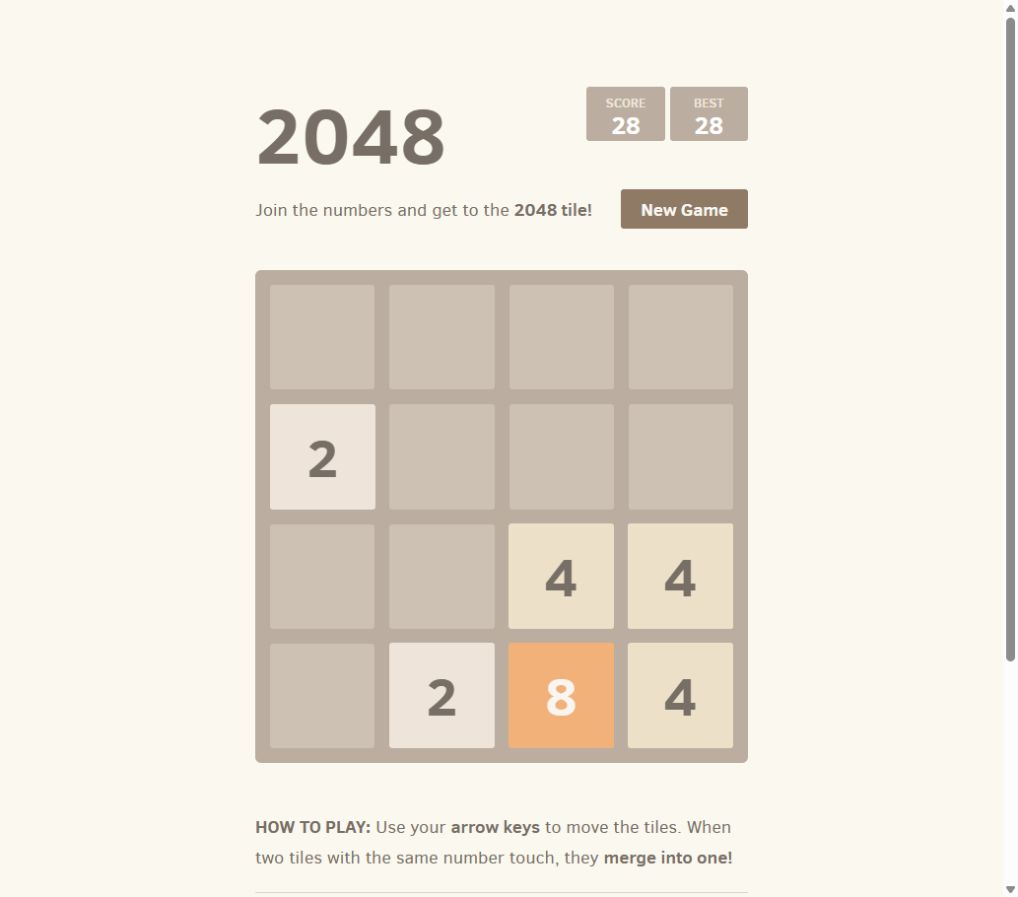
A downward move merged two 2 tiles into a 4. The score rose from 24 to 28, and the new 4 stayed above the existing 4.
Read the rightmost column from top to bottom. Before the move it contained an empty square, 2, 2 and 4. After pressing Down, the two 2 tiles combined. The newly created 4 did not merge again with the 4 beneath it during that move.
The two screenshots show scores of 24 and 28. A new 2 also appeared elsewhere on the board after the valid move. This is why a plan should distinguish the predictable slide and merge from the new tile that follows.
Try it: before a move, name which pair will merge and where its result will stop. If you expect a chain of two merges from the same newly created tile, revise the plan.
Try the next run
Use one idea from this guide in the 2048 player. Its game page includes controls and edition/source details.